Can VR Capture the Power of China’s Ancient Caves?
Under the blazing July sun, Zhang, a high school teacher from northern China, stood outside the Digital Exhibition Center of the Mogao Grottoes, a modern building designed to resemble the surrounding dunes. A shuttle bus would soon take him and other tourists to the foot of Mingsha Mountain, where they would see the original Mogao Grottoes: 492 caves containing Buddhist murals and painted sculptures spanning more than a thousand years, now strictly protected as a UNESCO World Heritage Site.
Zhang had just watched two introductory films at the center, “A Thousand Years of Mogao Caves” and “The Splendor of Buddha’s Palace,” the latter screened in its dome theater. His eyes sparkled with excitement. “It is so spectacular that I am speechless! I hope other heritage sites in China can be presented like this.”
The Mogao Grottoes in Dunhuang, northwestern China’s Gansu province, are the product of more than a millennium of cultural exchange between East and West along the historic Silk Road. Renowned for the extraordinary aesthetic and cultural value of their cave art, they attract large numbers of tourists. Yet the grottoes are intrinsically fragile, threatened by both the surrounding desert and the carbon dioxide and humidity generated by visitors.
To reduce pressure on the caves and ensure their long-term preservation, the Dunhuang Academy, which manages and researches the site, has been developing the Digital Dunhuang project since the late 1980s. More than 200 caves have been documented through photography, image stitching, and laser scanning, with the material transformed into online and on-site experiences spanning films, virtual and augmented reality, and museum exhibitions. These digital experiences have become an increasingly prominent part of visiting Mogao.
Putting “cultural heritage” and “digital technology” together creates an immediate tension. Heritage looks backward, toward the past and the old; technology looks forward, toward the future and the new. When the two are brought together, digital representations exist alongside the physical heritage itself, raising questions such as: what qualities of the original are irreplaceable, and to what extent can they be reproduced or conveyed digitally?
I conducted a year of fieldwork at the Mogao Grottoes between 2024 and 2025, spending long periods in both the physical caves and digital exhibitions and talking with visitors. While physical and digital exhibitions at heritage sites can tell separate stories, at Mogao they are closely intertwined. The tension between heritage and technology highlights both their differences and how they complement each other, as visitors often observed.
Among the visitors I spoke with was a middle-aged British artist traveling with her partner. The two had sharply contrasting reactions. She was fascinated by the distinctive smell inside the caves, a mixture of dust, moisture, and history that would be difficult to reproduce digitally. Her partner, by contrast, was perfectly content with the digital exhibitions. “I really got my fix! I could just go with the digital,” he said. He drew parallels with Lascaux Cave in France, where replicas receive visitors while the original, closed to the public since 1963, is preserved.
For some caves, digital representations are the only way visitors can experience their fragile artworks. Cave 285, built during the Western Wei period and containing inscriptions dated to 538 and 539, is one of Mogao’s most important early caves, renowned for its rich murals and diverse artistic styles. It is currently closed to the public for conservation, but a virtual reality exhibition immerses visitors in the stories depicted on the murals and even lets them use handheld controllers as drumsticks to play music alongside mythological beings.
Wang, visiting from the southern city of Shenzhen with her young child, told me: “I like it very much, and it is also child-friendly. The VR shows real scenes from the cave while telling the stories in detail. It even surpasses the real cave!”
For visitors like Wang, VR not only reproduces the physical cave but creates a space of its own, allowing them to experience it in a playful, multisensory way impossible inside the original. “I am so touched that I almost cried,” another visitor told me. “I know Cave 285 is not open to the public, so I am very grateful for the opportunity to see it up close.”
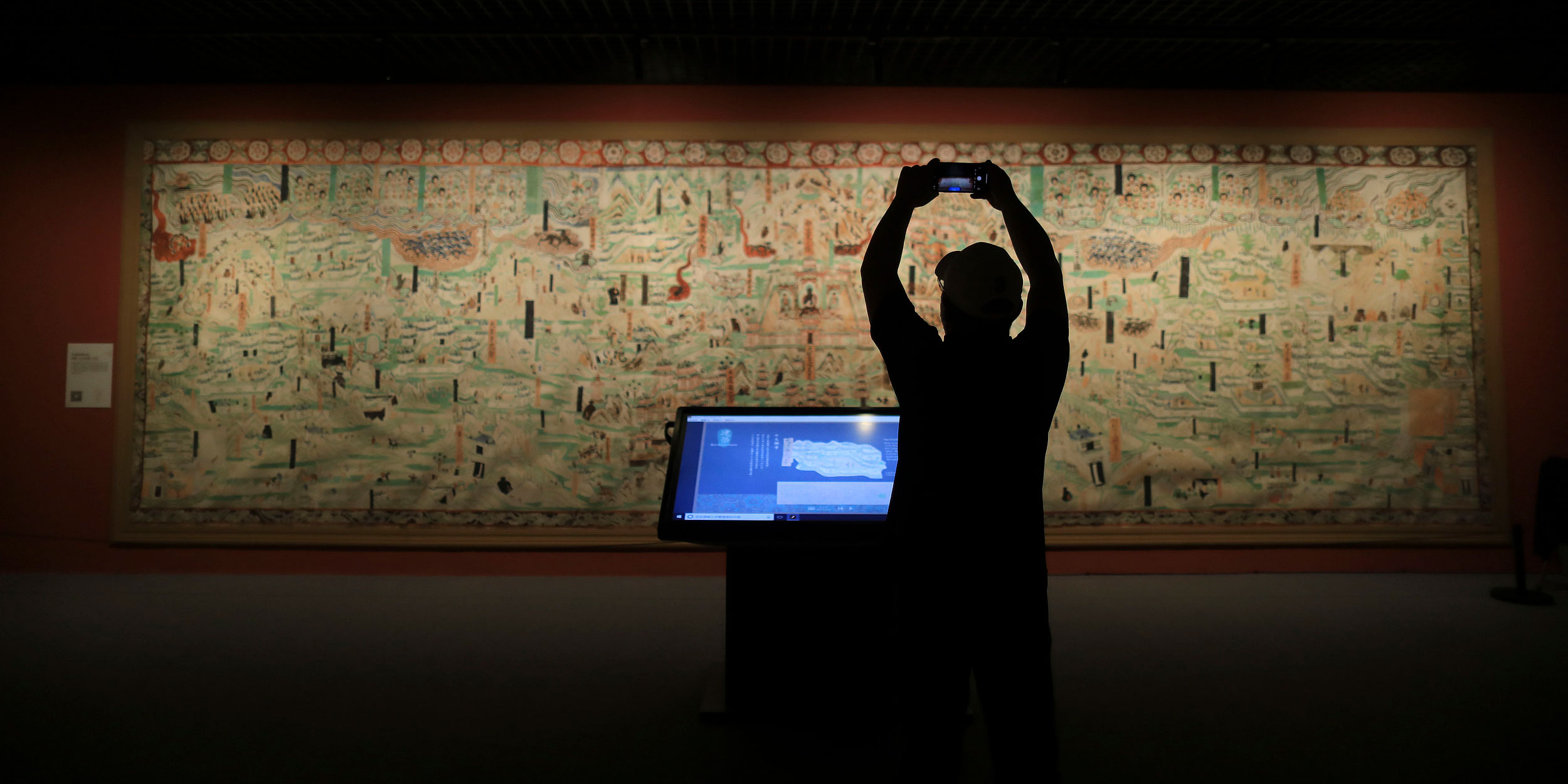
For caves that remain open, experiencing both their physical and digital versions can offer a more nuanced perspective on the art. Cave 61 contains the largest surviving Buddhist historical landscape painting at Mogao. Based on the geography of the Tang dynasty (618–907), the mural depicts pilgrimage routes leading to the sacred Mount Wutai, over 2,000 kilometers east of the caves. It is also featured in “The Splendor of Buddha’s Palace” in the center’s 360-degree dome theater.
Later, on a poplar-shaded path, a college student, Xiaoyang, reflected on the contrast. “When I saw the mural from Cave 61 on the big screen, it was so bright. It really looked real, but I knew it wasn’t. I couldn’t feel the traces of time. But when I actually stood inside the cave and faced the mural, I began wondering how ancient cartographers had trudged through Mount Wutai and how painters had depicted the scene on the wall.”
Her response points to what digital reproductions can lose even as they make the art more visible. On-screen, details are easier to see, but this digital representation weakens the power of age and decay that connect viewers to the mural and the people who created it centuries ago. The digital image shows what can be difficult to see inside the cave, while the physical mural confronts visitors with the passage of time. Together, they encourage visitors to consider both the image and the history behind it.
Another crucial component of Digital Dunhuang is the digital repatriation of manuscripts and artifacts now held overseas. In the early 20th century, the discovery of more than 70,000 manuscripts, paintings, and other objects in the Library Cave, or Cave 17, opened a new chapter in Mogao’s history. Most were removed amid the era’s turmoil. Now dispersed around the world, they are being brought together digitally through collaborations between the Dunhuang Academy and international institutions.
Adjacent to Caves 16 and 17 is a museum housing the exhibition “Treasure in Caves,” which recounts the artifacts’ dispersal and virtual reunification. Replicas of objects now scattered among collections worldwide stand side by side in rows of glass cases.
Visiting the caves and exhibition offers complementary experiences, making this place marked by loss feel slightly more complete. A woman in her 50s discussing Cave 17, a memorial cave containing a statue of the Tang-dynasty monk Hong Bian, said: “Cave 17 is a physical place that has endured these historical events. The exhibition tells their story and shows the artifacts, so I can hear the echoes of history and finally breathe a sigh of relief.”
Like these visitors, I have found my own answers to questions about the authenticity. Now writing about Dunhuang from afar, I often revisit photographs from my fieldwork. Yet when I close my eyes, I can still recall the original caves: their warmth, their solemnity, and their sense of history.
The tension between the digital and physical does not necessarily have to be resolved in favor of one or the other. Digital representations can make inaccessible caves available, reveal otherwise difficult-to-see details, and reunite objects that have been physically dispersed. But they can also erase the traces of time and distance that give the originals much of their power. At Mogao, the two forms are most effective not when one substitutes for the other but when they work in tandem to deepen the experience.
By presenting the grottoes from multiple perspectives while carefully controlling access to the physical caves, the Dunhuang Academy shows how digitization can expand our understanding of authenticity rather than simply imitate the original. Perhaps another thousand years from now, the Mogao Grottoes will still move us, both through their carefully preserved physical form and through the digital versions that capture, interpret, and transmit them.
According to research guidelines, all names in this article are pseudonyms.
Portrait artist: Wang Zhenhao.
(Header image: VCG)